tobias revell a british interaction designer, has documented the dharavi slums of mumbai, india, showcasing how genetically modified mushrooms have revitalized the poverty stricken city in the 'new mumbai' of the future. originally from amsterdam, highly experimental biotechnological samples had been stolen from a dutch lab, where the fungi had been re-engineered to exponentially grow in size for use as narcotics and to create a micro-economy based off the material. as the new plant became introduced into the overpopulated but highly educated urban mass of the slums, the locals began to use it to their advantage - to both exercise freedom from the state and to provide suitable living conditions. today, the mushroom is used to harvest energy as well as provide providing heat, light and building material
for the residents of the slums of dharavi. - From Designboom.
7.23.2012
Fungus POWER
11.20.2010
life design
Craig Venter is pretty amazing. He also has his Synthesized organism. One which he says will translate CO2 to fuel. Think about it. Self replicating species whose parent was a computer.
Hello Singularity. Is that you at my cell wall?
10.23.2010
ACADIA 2010
So I am here right now- there is a lot to write about yet I won't attempt this right now. Just to give a small overview and highlights. Speakers that spoke this morning were :
Alessandra Ponte, Associate Professor, University of Montreal, Alberto T. Estevez, Director Biogenetic Architecture Universitat Internacional de Catalunya, Jenny Sabin, Lecturer, University of Pennsylvania, Tomasz Jaskiewicz, Scott Crawford.
Currently in a pleasant overload of information. On day 3 of the conference. I need a moment to digest.
Sad not to see the gentlemen from the BIOS Design Collective not here.
9.04.2010
an answer to the archaic?
Rachel Armstrong is hitting home. I was talking about biomemetics in architecture as way of self organizing cells (and repairing them self.)
She also talks about metabolic materials. Not far off from what was proposed in the Inhabitable Organism (our METABOLISM!!!!)Rachel Armstrong is not an architect. She is a medical doctor, multi-media producer, science fiction author and arts collaborator. Through her current research that explores architectural design and mythologies about new technology, she has been working with scientists and architects to explore cutting-edge, sustainable technologies. 
Though I don't see her idea's too far off or "futuristic", Armstrong believes cities will be able to replace the energy they draw from the environment, respond to the needs of their populations and eventually regarded as "living" similar to parks or gardens. (I guess she was a big fan of Ecotopia as well....) This is also similar to point others have made about Open Source Urbanism (as the natural world can be considered as open source... let's think about mulit-poos.)
"Scientists need to work outside their own areas of expertise to make new technologies that are pertinent to the 21st century and to collaborate, both with other scientific disciplines and the arts and humanities."Rachel Armstrong
(I KNOW RIGHT?!)
8.29.2010
in Social Media Publicity grows like cancer
Mitchell Joachim
| The Colbert Report | Mon - Thurs 11:30pm / 10:30c | |||
| Mitchell Joachim | ||||
| www.colbertnation.com | ||||
| ||||
8.23.2010
pee shit bricks...
The built environment that we all know and sometime love consists as is a limited palette of traditional, static materials such as concrete, glass, steel, and wood. These materials embody high concentrations of energy, with most components of concrete and steel mined from non- renewable resources. Not that great for the sustaining the environment or leaving a minimal carbon foot print. (Though LEED and other associations will give you brownie points otherwise....) Did you know 40% of global carbon dioxide is linked to the construction industry, primarily due to material production and disposal? So why not "grow" bricks? Biologically grown materials can be pollution free (note can be- they might just have a lower production of waste until we figure out how to recycle it). These grown materials also have the potential to contain a low embodied energy and could be produced as part of a local ecosystem.
Dosier has been working on a new breed of biologically “grown” bricks that are durable, sustainably manufactured, and easily produced from readily available materials. These “Better Bricks,” can be “grown” from sand, common bacteria, calcium chloride, and urea. (There's the pee again!) Growing bricks instead of being baking them, which consumes a ton of energy, saves and produces a great amount of energy!
Something to think about. I know it has been a while- but I have just been occupied with settling down in my new home/city/etc. Inhabitable Organism is on the rise! And I have a feeling it will be a pissing good time....
8.22.2010
pee power again!!?!
Youtricity, a research group of the Engineering & Physical Sciences at Heriot-Watt University, is developing the world's first Direct Urea Powered Fuel Cells. They are focusing their efforts to water treatment/purification and renewable energy where urea is a contamination problem.
This revolutionary new fuel cell takes in urine and out comes electricity and clean water. Brilliant! This would mean wonders for third world energy and clean water problems.
How does this magic work? The fuel cells convert chemical energy into electricity through a series of reactions between a fuel and an oxidant. Urea is a great (and redily) replacement hydrogen or methanol fuels. The only catch is that the batteries don't store any chemical energy inside them. This means they can only operate when external fuel sources are supplied. So keep drinking that aqua.
This yellow wonder is the brainchild of Doctors Shanwen Tao and Rong Lan. It uses cheaper materials for its membrane and catalysts. It uses a non-toxic, non-combustible fuel: urine. Talk about reducing your carbon foot print. Did you also know that urea is also known as carbamide? Urea is not strait urine and comes from humans and mammals. These batteries work with both.
Dr. Tao explained his inspirations::::
"Growing up in rural eastern China I was aware of the use of urea as an agricultural fertilizer. When I became a chemist and was looking at fuel cell development I thought of using it in the process. We are only at prototype stage at present, but if this renewable material can be used as a commercially viable and environmentally friendly energy source then we will be absolutely delighted, and many people around the world will benefit."
Urea elsewhere- it is being used in trucks and other heavy-duty vehicles to reduce nitrous oxide emissions. Other interesting urea items are Urea-formaldehyde, aka pee plastic! This is a non-transparent thermosetting resin or plastic. These resins are closer to you than you think. They are used in adhesives, finishes, MDF, and molded objects. It also has a high tensile strength and used to glue wood together! Ah, the resources we piss away everyday!
7.08.2010
Wave Power!
In the 1940's the modern scientific pursuit of wave energy was pioneered by Yoshio Masuda. His experiments tested various concepts of wave energy devices at sea, with several hundred units used to power navigation lights. In 1973, a new interest was invigorated due to the oil crisis then.
Some other things being done now --- an Australian company BioPower Systems uses the biomimicry of the floats of swaying sea plants in the presence of ocean waves in its BioWave system. The Oyster wave energy converter (featured in the video) is a hydro-electric wave energy device. The wave energy device captures energy from nearshore waves and converts it into usable electricity.
Wave- cool!
3.27.2010
bees breeze.
The walls and exterior skin is used as a translator of energy. (passive) Imagine if the the dirt and bricks were embedded with photovoltaic chips as well or chloroplast-like cells that could not only keep the building cool and warm but transfer the energy to light and power for the inhabitants. This existing "dead" system could have a new life of its own.
Chloroplasts, the organelle that turns light into energy through photosynthesis, have been the long time inspiration for the solar panels as we know them. To this point they are still large and not nearly as integrated as their original inspiration. But let's get a bit smaller. Material scientists at the Nano/Bio Interface Center of the University of Pennsylvania have taken it there. They have demonstrated the transduction of optical radiation to electrical current in a molecular circuit. The system, consisting of an array of nano-sized molecules of gold, respond to electromagnetic waves by creating surface plasmons that induce and project electrical current across molecules, similar to that of photovoltaic solar cells.
Dawn Bonnell, a professor of materials science and the director of the Nano/Bio Interface Center at Penn, and colleagues fabricated an array of light sensitive, gold nanoparticles, linking them on a glass substrate. By minimizing the space between the nanoparticles to an optimal distance, researchers used optical radiation to excite conductive electrons, the plasmons, to ride the surface of the gold nanoparticles and focus light to the junction where the molecules are connected. This plasmon effect increases the efficiency of electrical current production in the molecule by a factor of 400 to 2000 percent, which can then be transported through the network to the outside world. Pretty amazing. These new cells could be infused into even clothing. Just think about it.
12.25.2009
Breathing Builds
9.10.2009
stomach in the trees
8.25.2009
Living Bridges
For the logistics behind construction to make a rubber tree’s roots grow in the right direction, the Khasis use betel nut trunks, sliced down the middle and hollowed out, to create root-guidance systems. Technically, the roots could be guided to any direction, say even to become a dwelling.
The thin, tender roots of the rubber tree, prevented from fanning out by the betel nut trunks, grow straight out. When they reach the other side of the river, they’re allowed to take root in the soil. Given enough time, a sturdy, living bridge is produced.
8.24.2009
a truck grows in brooklyn
A solar powered timelapes camera is documenting the growth and adventures throughout the summer. Every month they have also been releasing a short as well.
With the new passing of H2749 and CODEX, this might be our only option one day. This sneaky bill which Obama is behind (wtf? when Michelle has a garden at the white house??!Was that all a front?) Her garden is pretty much illegal unless she can dish out $500 dollars. My garden is as well. So would be TRUCK FARM. (more on this bill in its own blog)
Possible we will revert to what I saw when I went to visit my family in Maierato, Italy. Trucks would come around selling goods. There was a mattress truck, egg truck, you name it truck. There was also a boy going around with a cart and a goat selling FRESH FROM THE GOAT goats milk and cheese. Next we will have the village green back.
7.16.2009
blamable sustainable
Liftfrance09: John Thackara from Lift Conference on Vimeo.
I love the part about the photoshopping green/grass to make it "sustainable."
John Thackara is the director of Doors of Perception. This is the talk that he gave at LiftFrance09. This talk points in on the the role of design in finding solutions to the ecological crisis. Are you in the Future business? Or the business of now? He invites the audience to avoid terms such as "future" or "sustainable" as they maintain a certain distance to the problem we face. The important point is that the resources to be put in place already exist and that they might not necessitates complex technological developments. Though I would disagree to a degree about the technological developments not being necessary I do believe everything we need is already at our finger tips. The waste in the system is not just noise but energy. But the point is how you TWEAK the waste/noise to be back into the system, be it living walls or energy retrieval devices.
6.27.2009
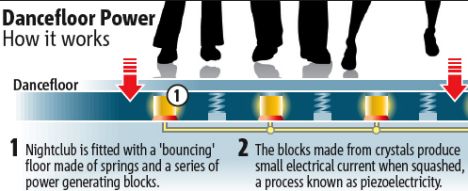
This is very similar to the eco-energy-generating-dance floor that is in England. The floor harnesses power from the pounding of clubbers’ feet and convert it into electricity. The harder you party the more you WORK, from the physics sense. (Think of Ciara's new song work.)
The club is quite pricey at a £10 entry fee but those customers who can prove they travelled there by
foot, bicycle or public transport will be allowed in free. That dance floor could be your bed room floor! Or imagine some sleazy motel powering its blinking sign from the people getting it on inside... It's just recycling the energy.
6.21.2009
Notable tweets.
Here are some of my favorite ones so far. He had said something about John Thackara as well.
If we all talk about "the future," it removes us from being responsible for what we do today -- we trample the world as it exists now!
Two human beings: a sick person and a doctor. What is the lightest, smartest and quickest way to connect them to each other?
Monumento in Brasil: "No more 'stuff' is needed! We have favelas here and four thousand empty office buildings."
6.18.2009
Bio®ebo(O) T
"François Roche
Bio®ebo (O) T
“an architecture of moods”
State of advance (02) of the research which will be made public in January 2010, at the Laboratory - Paris.
In the continuation of Ive heard butt presented to the MAM in 2005, this second opus attempts more precisely to work out the computational, mathematical procedures and robotics with collaborations of François Jouve, Marc Fornes and Stephan Henrich. The urban biostructure thus generated remains contingent with protocols of indeterminations, fact of successive aggregations which Re-articulate the bond between the individual and the collective, but not only.
It will be the occasion to question this turbid zone ''of the emission and the collecting of the désirs' ', by the nonintrusive collection of signals neuropsychological and to seize moods of the future purchasers like as many generative inputs of the diversity and the heterogeneity of livable morphologies.
François Roche is member of R&Sie (N), limited liability company of architecture founded with Stéphanie Lavaux in 1993. He is of more teaching in ''the advanced studio' 'of Columbia University Gsapp/New York and of Angewangde School/Vienna in Austria.
François Roche, through the limited liability company was invited to six recoveries with the Biennale de Venise, took part in more than one score of international exhibitions and gave more than one hundred of conferences abroad. In France, this production structure and of research asserts a statute of native immigrant."
6.08.2009
Your Future Your School

Based on a month long collaboration with the sixth grade class of struggling middle school with low performance statistics in a rough urban neighborhood, this design presents the collective predictions and prescribes suggestions for a better learning environment, directly from those who hunger for the betterment of their future. The classroom of the future needs to be an environment which perpetuates active symbiosis; a place where students are teachers, teachers are students, the space is a teacher, and the space is a learner. Spaces need to be smarter as the students will teach the classroom how to better appropriate itself to them. Without a doubt, technology needs to be more efficiently infused with the learning process.
when podcasts are integrated into the curriculum. Wireless Internet is a consistent and necessary amenity for the students. By maximizing the educational potential of these existing conditions, teachers can simultaneously collaborate with classes around the world and provide the opportunity for students to discus and learn about other cultures first hand from fellow students around the world. If the laptops are unavailable, the integration of cell phones and social networking services such as Twitter or Ning can also introduced into the curriculum to act in a similar capacity. With the cell phone, the student can text message their answers or questions to display them at the front of the room. If a Smart Board is out of the budget, a projector attached to the teacher's laptop can fill its role. This promotes group learning from everyday actions that an educator might find to be traditional distractions. If the student is apt to text messaging about social happenings, then they would also be apt to text message about their answer to a question posed the board. This promotes healthy intellectual discourse and does not deter students from learning but rather encourages the use of everyday, attainable technology in their learning environment in a similar capacity to the technology's use in the professional world of which these students hope to one day be productive members. Due to the nomadic nature of laptops and other hand held communication devices, the classroom lends itself as a flux of striated and smooth spaces. All spaces are activated by the inhabitant's (students' and or teacher's) presence and are re-arrangeable and modular.
The space attempts to appeal to all types of learners: the visual, auditory, kinesthetic. There is a spectrum of place where the students learn, relaxed space to rigid space. Relaxed space has beanbag chairs or lightweight couches that can be moved for group or individual work. This area, or the break out space, is a place where students can feel at home in the classroom. The beanbag chairs are constructed out of recycled materials as are most of the objects in the space. If local materials are more economical and sustainable, they will be employed into the classroom. The break out space is also acoustically insulated so that students can come and study and read to stimulate themselves and to erase the stigma of "boredom" in the classroom. Boredom is a frequent complaint of students in the classroom. From existing in a media overload culture, it is hard for most to concentrate without multiple stimuli. The students are not necessarily afflicted with Attention Deficiency but instead simply require multiple stimuli to concentrate, absorb, and question the information they are intellectually ingesting. Carpet from recycled materials defines the space as well as brings a sense of homeyness to it, as well as a hearth or fireplace for the students to congregate around. A small satellite library with physical books chosen by the students and access to digital libraries and A Smart Table will also help to amalgamate the intellectual and informal cues of the space. The rigid space is similar to a traditional classroom setup with desks and chairs yet the desks are table units with at least two students to a unit. Each student has a partner to collaborate with throughout the term.
The tables can then be combined to make a classroom in the round for better discussions or even larger groups. Group learning encourages participation for living in a global society with the understanding that multiple perceptions and actions affect others. An area for recycling and sustainable energies in action encourages students to learn and live with an ecological conscious. So far all of the above can easily be included in a retrofitting project at an existing school.
The classroom needs to be integrated with natural elements to inspire the students with real life as well as digital influences. Opening to a classroom-specific outdoor space with access to an edible garden or edible green wall as a product of the space allowance will add to the curriculum and nutrition of the students. The incorporation of a water element with living fish that are the responsibility of the students lends itself to hands on science explorations and lessons. For the truly ambitious school that is dealing with overcrowding, organic and living construction can alleviate the use of the "temporary classroom." By using controlled cultured plant growth, the skin of the classroom is living and changing. The structure of this growth of living materials such as native or non-invasive trees or shrubbery uses a prefabricated system to direct its form.
The possibility of this plant as a nutrient supplier, aka an apple or a fig tree, offers healthier strategies for the student suggested snack and soda machines. A sitting area outside with a natural moss or grass lends itself as the setting of an outdoor classroom. Composting and water harvesting are also part of the outdoor curriculum. The school, if not the classroom itself, will obtain part of its energy from solar panels and insulate itself with inhabitable green roofs.As per request of the students, the classroom should have direct access to the restrooms with efficient Grey water toilets. The main reason for this was that other students use their opportunity to go to the restroom to skip class and socialize. With this program shift of restrooms reintroduced into the classroom program, the area of the hallway outside the classroom is not longer just a through space and can then be augmented with other small niches for breakaway and socializing areas. Socialization does not have to be frowned upon and should be thought as part of the curriculum. Thus socializing will not be seen as a distraction from learning but a method of learning itself. Another important factor is the introduction of teacher-specific space. At the end of the day, the teacher is the one encouraging and inspiring the students to try harder. Teachers also deserve better spaces and their own breakout rooms and an inviting teacher lounge that is not just a dark room with few chairs and a microwave. An overall design motive is to have as much daylight as possible with out over heating the space. Larger windows and glass garage doors can be added to existing walls. When applicable, light wells to the sky similar to James Turrell's Sky Space pieces can leak sunlight from above. Shading and water protection is also provided. Other than day lighting there are low hanging LED lights equipped with proximity sensors so that when a student is near or below it will turn on.
All in all, the classroom of the future should be comfortable and a place that is more attractive and safe than the streets. School can be a fantastical place where the walls are filled with living plants instead of bars. They have the power to provoke the minds of the students and cultivate their ideas, but only if the space is inviting and receptive to creativity and cooperation. The space has to allow for itself to be occupied or claimed by that group of students and reclaimed by the next. The classroom cannot deny its previous history by being sterile but can celebrate learning as a compilation. The students requested clean spaces but clean does not have to mean sterile. Due to the context of the urban school, a graffiti wall should be placed in each classroom where students have permission to tag on designated areas. Graffiti will be seen as art and not as an act of vandalism. Thus, the classroom needs to reflect the community in which it exists while creating an intellectually stimulating and safe community within itself.
6.05.2009
Hydoponics amoungus.
LOST IN PARIS
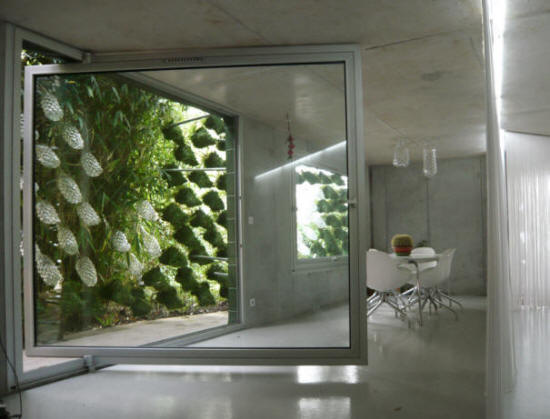
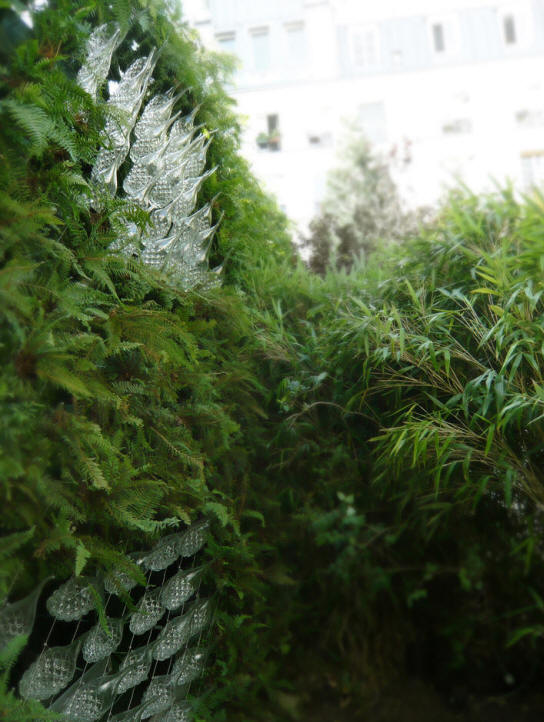
It s the story of an urban witch living behind a rear windows designed as a duck cabana. As alchemist, she feeds the plant with drop by drop hydroponics system watering liquid substances coming from the bacterian chemical preparation in 200 beakers disseminated in the ferns surfaces.The neighborhood is both attracted by the green aspect and repulsed by the brewage and the process to produce it.
6.03.2009
edible architecture
The Incredible Edible House was designed by LA-based Rios Clementi Hale Studios. This is a thorough design for a concept home. The Edible House is constructed out of three prefab containers stacked on top of one another. The mixture of living and prefab is a fantastic combo bringing living home aspects to an attainable realm.
This house is stacked with vertical axis wind turbines mounted along the roof placed in front of an evaporative cooling reservoir. The energy production and cooling system are integrated into the house, reducing energy usage dramatically. This is what one could call a dry metabolism, self sustaining itself. Of course, the house comes with a photovoltaic awning for energy production and shading as well as adjustable doors on the sides of the house for natural cross ventilation.
The hydroponic skin covering the living quarters with a multitude of plant, vegetables and fruits starts to creep towards a wet metabolism. The living wall on the outside of the house reduces heat gain to the house as well as nourishment for the people inside.
This is close to the Edible Estates from Fritz Haeg.