Mitchell Joachim
| The Colbert Report | Mon - Thurs 11:30pm / 10:30c | |||
| Mitchell Joachim | ||||
| ||||
| The Colbert Report | Mon - Thurs 11:30pm / 10:30c | |||
| Mitchell Joachim | ||||
| ||||
 Waste not want not? Well, Ginger Krieg Dosier, an assistant architecture professor at the American University of Sharjah in the United Arab Emirates, is making what some call waste into building materials. What if we could grow and cultivate architectural materials by employing natural minerals and microorganisms?

Youtricity, a research group of the Engineering & Physical Sciences at Heriot-Watt University, is developing the world's first Direct Urea Powered Fuel Cells. They are focusing their efforts to water treatment/purification and renewable energy where urea is a contamination problem.
This revolutionary new fuel cell takes in urine and out comes electricity and clean water. Brilliant! This would mean wonders for third world energy and clean water problems.
How does this magic work? The fuel cells convert chemical energy into electricity through a series of reactions between a fuel and an oxidant. Urea is a great (and redily) replacement hydrogen or methanol fuels. The only catch is that the batteries don't store any chemical energy inside them. This means they can only operate when external fuel sources are supplied. So keep drinking that aqua.
This yellow wonder is the brainchild of Doctors Shanwen Tao and Rong Lan. It uses cheaper materials for its membrane and catalysts. It uses a non-toxic, non-combustible fuel: urine. Talk about reducing your carbon foot print. Did you also know that urea is also known as carbamide? Urea is not strait urine and comes from humans and mammals. These batteries work with both.
Dr. Tao explained his inspirations::::
"Growing up in rural eastern China I was aware of the use of urea as an agricultural fertilizer. When I became a chemist and was looking at fuel cell development I thought of using it in the process. We are only at prototype stage at present, but if this renewable material can be used as a commercially viable and environmentally friendly energy source then we will be absolutely delighted, and many people around the world will benefit."
Urea elsewhere- it is being used in trucks and other heavy-duty vehicles to reduce nitrous oxide emissions. Other interesting urea items are Urea-formaldehyde, aka pee plastic! This is a non-transparent thermosetting resin or plastic. These resins are closer to you than you think. They are used in adhesives, finishes, MDF, and molded objects. It also has a high tensile strength and used to glue wood together! Ah, the resources we piss away everyday!
 With all the interest in swarming and termites, what happened to the bees ingenuity from the populous spectrum? In Syria, one of the traditional Middle Eastern construction keeps cool with out electric hungry HVAC systems. These "beehive" homes are located along the Aleppo and Euphrates Rivers. How they work in keeping the inhabitants cool is through their thick mud brick walls that trap in the cool and keep out the sun. Due to the mass they are similar to Trombe Walls for passive solar heating and cooling. They also let little light in but do have some openings for ventilation. The high dome structures move the hot air away from residents sleeping on the bottom.
Chloroplasts, the organelle that turns light into energy through photosynthesis, have been the long time inspiration for the solar panels as we know them. To this point they are still large and not nearly as integrated as their original inspiration. But let's get a bit smaller. Material scientists at the Nano/Bio Interface Center of the University of Pennsylvania have taken it there. They have demonstrated the transduction of optical radiation to electrical current in a molecular circuit. The system, consisting of an array of nano-sized molecules of gold, respond to electromagnetic waves by creating surface plasmons that induce and project electrical current across molecules, similar to that of photovoltaic solar cells.
Dawn Bonnell, a professor of materials science and the director of the Nano/Bio Interface Center at Penn, and colleagues fabricated an array of light sensitive, gold nanoparticles, linking them on a glass substrate. By minimizing the space between the nanoparticles to an optimal distance, researchers used optical radiation to excite conductive electrons, the plasmons, to ride the surface of the gold nanoparticles and focus light to the junction where the molecules are connected. This plasmon effect increases the efficiency of electrical current production in the molecule by a factor of 400 to 2000 percent, which can then be transported through the network to the outside world. Pretty amazing. These new cells could be infused into even clothing. Just think about it.
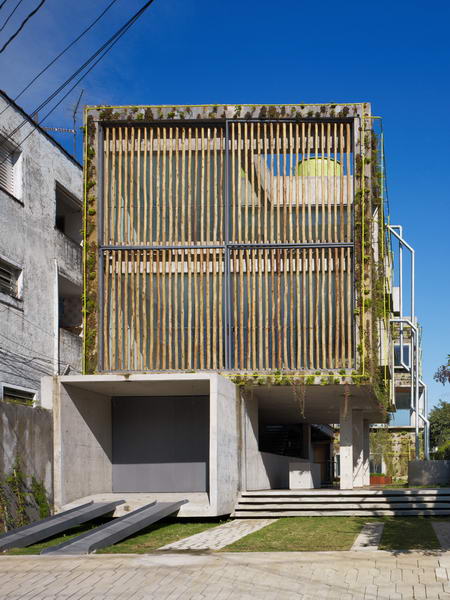
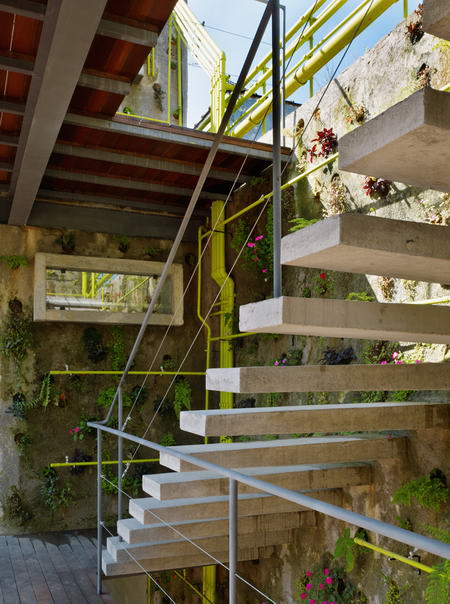
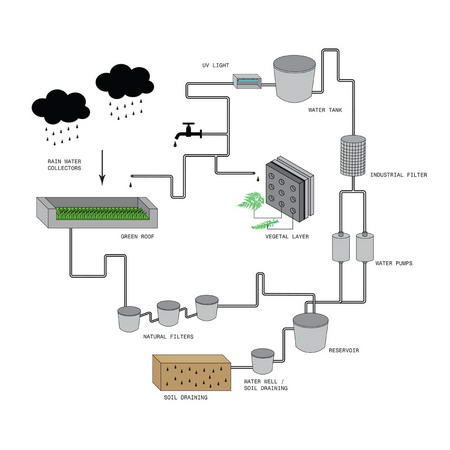
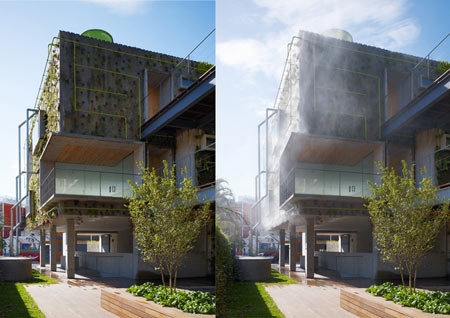
 Harmonia 57 is Triptyque’s office building located in west Sao Paulo, Brazil. This building works as a living body. It breaths, sweats and modifys itself, transcending its inertia. The walls are simple, thick, and covered externally by a vegetal layer, working as the skin of the structure. This dense wall is made of an organic concrete that has pores, where several plant species grow, giving the facades a unique look.
 Wouldn't be nice to live and eat in the trees? You can in Auckland, New Zealand at the the Yellow Tree House Restaurant by Pacific Environments Architects. 10m wide,over 12m high and 10m off the ground, this timber trussed structure is basically curved fins of glue-laminated pine. The roof is made of acrylic sheeting.
 In the forests of Meghalaya, India, the War-Khasis people have used the growth during the rainy season to their advantage. They guide the roots of an abundant species of rubber tree in order to create these living organic bridges. These are so sturdy that they can support the weight of up to fifty people .
  Because they are alive and still growing, the bridges actually gain strength over time – and some of the ancient root bridges used daily by the people of the villages around Cherrapunji may be well over five hundred years old. The root bridges, some of spanning over a hundred feet long, take ten to fifteen years to become fully functional. The time is not that far off from a getting a building built today.
 This is quite similar to the FAB Tree HAB by Terreform. Instead of using the betel nut trucks, they propose to use prefabricated Computer Numeric Controlled cut reusable scaffolds. Imagine if Levittown was grown instead of built?
 Filmmakers Curt Ellis and Ian Cheney have revved up mobile living and food to a whole new level.TRUCK FARM is their brilliant film and food project featuring a 1986 Dodge Truck. By combining green roof technology, organic compost, and heirloom seeds, they have created a living, mobile garden in the streets of Brooklyn. The spacial concept of this is amazing. As every person who has a garden speaks about the "land" and ownership of static space, the truck shifts that notion and reiterates how dynamic the city is but at the same time redefining our innate need and wants to independently grow our own food.
Liftfrance09: John Thackara from Lift Conference on Vimeo.


 Posts
All Comments
Posts
All Comments


