5.07.2009
It's Alive
Theo Jansen has created these beautiful walking beach animals. They are aware of their place in space and their environment. His newest creatures walk without assistance on the beaches of Holland, powered by wind, captured by gossamer wings that flap and pump air into old lemonade bottles that in turn power the creatures' many plastic spindly legs. The walking sculptures look alive as they move, each leg articulating in such a way that the body is steady and level. New robots are now modeled with such joinery. They even incorporate primitive logic gates that are used to reverse the machine’s direction if it senses dangerous water or loose sand where it might get stuck.
The fact that they are self powered is a kick in the pants to why more buildings can't be that way. Yes, we have integrated wind and sun more but really it is not an everyday occurrence. These sand beasts that Jansen has made are low tech and could be reproduced. Imaging if you lived inside of one of these beasts, and not only was the wind powering the "animal" and what ever else you plugged into it but you with your movements were also attributing to its energy?
Would that then be the inhabitable organism?

5.06.2009
It came from the depths!
 If life really originated from the waters, why not go back there? Cesar Harada and his team are building a floating architecture that evolves like a living organism as it moves across the sea. This Laboratory was initiated by Cesar with his writing about open architecture and his experiments on bioarchitecture in urban contexts. The Open Sailing project is coming along with the goal of being truely an open-source development of an International Ocean Station.
Open_Sailing 4 minutes concept from cesar harada on Vimeo.
I hope to update more as it comes in. They have started construction on the station. Another great sea addendum is a recent project by Bios Design Collective. This project designed by Charles Lee. He produced this model of a sealife inspired boat dock. He incorporated the idea of communal gathering spaces in boat communities where trade and work can be done before retreating to the privacy of your quarters. If there was farming involved, it would be more similar to the Harada's project.
Acconci Studio designed in Korea a performing arts center for a floodable island. This project relates due to its capability to adapt and change. Some words from Acconci::
DROWNED WORLD. The floodable base of the island is a landscape of no-landscape. It’s other-worldly but not untouchable; it’s usable, walkable – you walk in and out of craters and crevices, you sit inside the craters…
HOVERING WORLD. The Performing Arts Center proper is rotated on the floodable base of the island; it’s cantilevered off the base, it escapes floods, it hovers above the water like a spacecraft.
TUBE-TO-TUBE, VEIN-TO-VEIN. The skin is sucked into the body of the spaceship to make an access. The access tube is sucked in to make a circulation-tube; one tube is sucked in to make another, the tubes take you up and down and across the spaceship, as if through the circulation-systems of the body.
BLOWING BALLOONS. The skin of a circulation-tube is sucked in, stretched out, to make an opera house, concert halls, restaurants…
STRANDED IN THE JUNGLE. The space in-between the programmed spaces is landscape, interior landscape: it’s a jungle. You stop off here on your way to a theater; you enter on different levels, it’s as if you’re floating through the jungle.
AN INSIDE OF OUTSIDE. The perforated surface of the spaceship lets sunlight in, into the jungle. It rains and snows inside the jungle.
COMING IN OUT OF THE WATER. If you don’t want to walk or drive across the bridge, you can come to the island by boat; you dock your boat in a crater. The largest craters are occupied: they’re filled with transparent capsules, that function as hotel rooms.
GOING OUT INTO THE WATER. The hotel capsules are tethered to the craters on pistons; when the river floods, the hotel capsules float.
Who is ready to take this out to sea?
4.07.2009
Bugging out.
 Out of batter power you say? Well, let me just fetch some of these viruses for you and you'll be off in a jiffy. How long do we have to wait till this is part of our vernacular jargon?
At MIT, a team led by Angela Belcher has genetically engineered viruses to excrete certain proteins that react with chemicals introduced to the environment to create complicated structures much like life forms. The viruses are genetically programmed to first grow the iron phosphate battery electrode material, then pick up an individual or bundle of carbon nanotubes that then wire the electrode for fast energy transfer. The battery created is only big enough to power a calculator but the same technique could be used to make batteries for cars, or maybe even ones home or at least plug in appliances.
The recipe for this energy is simple:: all you need is the virus (easily multiplied exponentially in a lab) and the raw materials. Now, it's not available at your local Ikea just yet. The batteries being produced are not at the standard of traditionally designed nanotech batteries due to their shorter cycle before they start to loose charge. I say give the team at MIT a few months and it should be up and running.
Unfortunately, the batteries being produced are not up to the standards of traditionally designed nanotech batteries. They can only go through about 100 cycles (vs. more than 1000 for today's batteries) before starting to lose their charge. Of course, the team is confident that they can direct the viruses more effectively and increase that number significantly.

Now I am still waiting for them to teach cancer to be a building material. Maybe a field trip is in order.
Source1:ecogeek. Source2:greentechmedia. Source3:inhabitat.
3.21.2009
Open Urbanism
The transition from physical to virtual spaces means that there is less opportunity to physically interact in public spaces. Historically public spaces were used for celebration, today they are used for anonymous mobile calls. We would like to explore the ways in which the tangible aspect of physical space might be re-introduced into our virtual interactions through an exploration and discussion of - among other things - responsive architecture. The people in the panel above are Mouna Andraos, Francesca Birks, Joshua Kauffman, and Molly Wright. Side note about the amount of women.
Mouna Andraos worked on the Public Farm Installation Work AC did for PS1 last year. She is a designer and artist working on interactive objects and installations as well as in web, electronics and video. Recently she was a R&D fellow at Eyebeam's OpenLab where she researched the possibilities of open source and sustainable design.(wink) She's also been researching the intersection of established crafts and emerging technologies as a means to generate innovation. Lo tech Hi tech if you will. I appreciate the analogue digestions of technology.
Francesca Birks is an Analyst within London’s Foresight, Innovation & Incubation (FII) group at Arup, where she leads demographics research. This group identifies and researches emerging global trends which will have an impact on the built environment. She is also a researcher for Arup’s Drivers of Change initiative. She doesn't look at just the numbers but the stories of the demographic research behind the situations and the environments. She's pretty much studying the future.
By living in cities we have an operating system already inlaid. How do we hack the city? Is graffiti a hack?
Mouna Andraos worked on the Public Farm Installation Work AC did for PS1 last year. She is a designer and artist working on interactive objects and installations as well as in web, electronics and video. Recently she was a R&D fellow at Eyebeam's OpenLab where she researched the possibilities of open source and sustainable design.(wink) She's also been researching the intersection of established crafts and emerging technologies as a means to generate innovation. Lo tech Hi tech if you will. I appreciate the analogue digestions of technology.
Francesca Birks is an Analyst within London’s Foresight, Innovation & Incubation (FII) group at Arup, where she leads demographics research. This group identifies and researches emerging global trends which will have an impact on the built environment. She is also a researcher for Arup’s Drivers of Change initiative. She doesn't look at just the numbers but the stories of the demographic research behind the situations and the environments. She's pretty much studying the future.
By living in cities we have an operating system already inlaid. How do we hack the city? Is graffiti a hack?
3.20.2009
It's Alive!
Choe U Ram is an amazing artist from South Korea. He has a deep understanding of robotics and creates these organic like structures that "live" autonomously almost. His show entitled Anima Machines was at the SCAI The Bathhouse gallery in Japan. Anima means soul in Latin. These things definitely have a life of their own.
 One of the best part of his work is that he treats these sculptures as specimens and gives them scientific names as well. This beautiful specimen is Una Lumino, 2008
 Scientfic Name : Anmopispl avearium cirripedia URAM
The materials are Metallic material, machinery, metal-halide lamp, and of course electronic devices. Here is the description from U Ram's website:: According to a recent report from United Research of Anima Machine- U.R.A.M,
a brand new species of mechanized sentient creatures has been discovered
operating within communities.Said to exhibit sophisticated and uniform behavioral patterns, this new species has been observed communicating actively with each other in colonies not unlike those of bees and ants.
Communities of these species gather and collect to form a giant mass of pulsing, breathing light, where they exchange information about where to find city energy, their main source of sustenance. Despite the inexistence of leaders or orders due to lack of command system, they seem to operate through interactive communication. When the lump with congregated independent living entities shines brilliantly, larvae swim in the air towards it and attach themselves.In addition, their eggs and larvae are reported to generate light by themselves. This living entity also emits redundant energy where city energy is necessary through communication by means of light. When looked down from a night plane, the city lights seem as if they are breathing,
and some are actually the scenes of these living entities’ interactive communication. Although these living entities are not easy to be distinguished from city lights due to darkness and distance, observations are occasionally made on their swimming act in search of greater community to adhere to.
This living entity has the form and movement the same as that of sea acorn (barnacle), which collects city energy in the air by moving their hard mouth.
They often attach themselves on some surfaces in factory machinery rooms, basements of old buildings and colorful neon signs within places with high human population density. It has been reported that the discovery of mechanical living entity community in the form of a giant bee hive is the first in history.
I love it how he talks about energy as well. mmmm sounds familiar....
3.18.2009
PEE POWER!
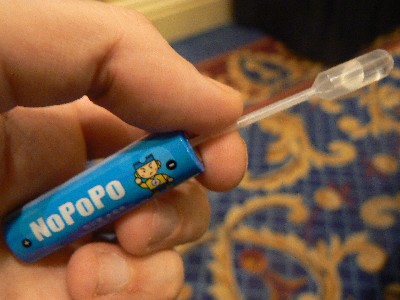 I have written before about the urine powered batteries in Japan. In a recent article on TreeHugger, they talked about pee as fertilizer. We are clearly wasting our waste. They bring up the points of how our pee regardless of our sewage system does find its contents in our drinking water eventually. Things such as antibiotics, birth control, and viagra are tainting our own organic systems.
 Gothenburg researcher Zsofia Ganrot has come up with an awesome new method of powdering pee which also removes traces of pharmaceuticals. She has figured out how to recover nutrients by freezing–thawing human urine in combination with struvite precipitation and nitrogen adsorption on zeolite. Shes pretty amazing. Zsofia did her PHD on ”Urine processing for efficient nutrient recovery and reuse in agriculture”. The Treehugger article continues to point out how much we PEE a year. Quite a good bit! Each one of us contributes about 7-9 liters of urine a week to sanitary systems for all those pissing in porcelain. According to Ganrot, in Sweden alone the collection of this resource could offset 1/5th the country's fertilizer use and reduce pollution from the transport of liquid fertilizer. Brilliant! It's recycling the noise into the system!
Or for a bigger stretch, what if we could pay for things with pee one day? It would be more of a barter system, but if we can sell our eggs and organs, why not our potential energies? I mean the dollar isn't worth the paper its printed on most days now so .. how bout something that's more "physical"? ENERGY IS THE ANSWER.
3.13.2009
ubik
Adam Greenfield wrote about the everywhere. This Sixth Sense is the next next of the iphone minus the calling. This is like the yellow arrow project but to a more seamless level. Philip K. Dick, can you hear us?
 Mmm may be I was on the right meme when I made this stop animation...

the wheels on the bike go round and round...
 and on his truck as well. a friend of mine, Zach Lihatch is currently trucking around while pedaling his book! (ha ha ha) He is putting together a book that documents bicycle cooperatives and co-ops in the US. If he comes your way, please send him some support. Here is his blog where he's been keeping track of his adventures thus far. Below is his mission statement::
Four the past four years, Zach has been involved with BICAS in Tuscon, AZ.
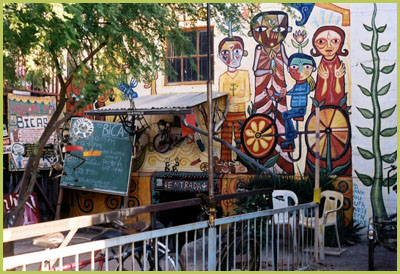 BICAS (Bicycle InterComunity Action and Salvage) is a cooperatively-run non-profit Community Center that through bicycle advocacy and recycling bikes, promotes education, art and a healthy sustainable environment. In conjunction, it provides services and opportunity for those in need.
The emergence of places like BICAS has occurred relatively recently. 10 years ago only one or two such projects existed. For a little history, BICAS itself was created in 1989 with a different mission than bikes. It was to help the homeless and originally called Bootstraps to Share, operating out of someone's garage. In 1994, Bootstraps to Share organizers decided to focus on what the group did best encourage people to ride bicycles. Thus, BICAS was born.
 BICAS is one of the country's oldest bicycle co-ops, along with Boston's Bikes Not Bombs and New York's Time's Up. It is only appropriate that Zach started his journey there. Now almost every major city some type of collectively run community bike space. Many of these groups have organized a network and meet at a national gathering to discuss their tactics, success stories, and challenges. All across the country, community bike shops have become a powerful resource, impacting all who come in contact with them.
I would even go to say that they have become a staple in our generations society. I almost expect there to be a bike co-op in every city because I grew up with one as well.
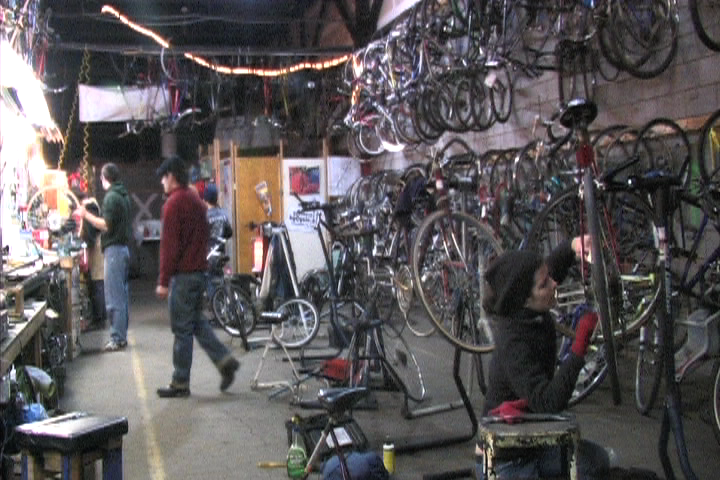 (shout out to free ride!) It's weird that that's what I assume. Fortunately, every city I've gone to in the US there's been one. Right after I moved to LA (like that week) I found a bike on craigslist and brought it to the Bicycle Kitchen. It just happen to be Bitchen Kitchen, the ladies night. I didn't know any one in LA and it was so welcoming! And re-affirming to be able to be fixing my bike in a strange new place.
Bicycle co-ops/collectives are the actualization of strong ideas. This once viewed as a sub-culture occurrence has blossomed into a current and appreciated amenity of the city and culture of its own. Zach's goal with this book is to bring attention to the bicycle co-ops and collectives and give this new and promising movement the recognition that it deserves.
 This next part is a direct quote (I've been paraphrasing thus far) but its too beautiful not to say it as it::"Thus far, there are many people who are involved in such endeavors, and countless others whom I believe could benefit from the knowledge that there is a practical and viable alternative out there. As individuals and communities, we can empower each other to reject those forces in the world that hold us down and to replace them with something much better. Through photo documentation, interviews and film [Zach] will be offering a glimpse into an alternative that is flourishing. "
It brings tears! So great! and SO TRUE! When I fix my bike and turned my Motobecane to a single speed all by myself I felt so empowered. This sounds lame. But bicycles truly contribute to bodies in space working in complete freedom. They cross lines of occupantcy and rights. When you are on your bike you become this beautiful hybrid of flesh and metal. With cars, you are still just in a pod, your energy is not recycled in any way and there is abundant waste. Freedom and mobility are extremely important to me and to what I think are everybody's rights (that and the right to information.)
I would also like to throw out there how much I have wanted this for a while::

So! Please contact Zach while hes on his journey. This book should be pretty awesome.
3.03.2009
getting down to business.
Juan Enriquez is one of my favorite speakers and perhaps one day one of my favorite people. He should be more popular than Paris Hilton that's for sure. Juan Enriquez is a lot of things other than a hero. He is (taken from his bio) a "bestselling author, businessman, and academic, is recognized as one of the world's leading authorities on the economic and political impacts of life sciences." He's alot. He is also the Chairman and CEO of Biotechonomy LLC, a life sciences research and investment firm. He is future based with a great sense of wit. The future is coming on us fast, no sorry, it's soon to be growing all over us. Please watch his lecture above.
Not only do the experiments and experimenters need to step up and take a more active role in day to day life, it is important for us as a society/civilization/terrestrials to educate our youth and future business men that real estate is not a reason to wear a suite. Sustainability is not for tree huggers. It's about every one involved in the system. The system is as simple as a transfer of energy from one element/person/thing to the next.
 Some of the clients that Biotechonomy has are also amazing. Xcellerex is working on revolutionizing the way biomolecules are developed, manufactured and commercialized. ( Biomolecules are any organicmolecule that is produced by a living organism, including large polymericproteins, polysaccharides, and nucleic acids as well as small molecules such as primary metabolites, secondary metabolites, and natural products. - wikipedia) Another client is Synthetic Genomics. Here's a quote from the founder and genius Craig Venter:
Work in creating a synthetic chromosome/genome will give us a better understanding of basic cellular processes. Genome composition, regulatory circuits, signaling pathways and numerous other aspects of organism gene and protein function will be better understood through construction of a synthetic genome. Not only will this basic research lead to better understanding of these pathways and components in the particular organisms, but also better understanding of human biology. The ability to construct synthetic genomes may lead to extraordinary advances in our ability to engineer microorganisms for many vital energy and environmental purposes."
- J. Craig Venter, 2003
We are living in very exciting times!
I still have to respond about open source urbanism.
2.27.2009
imagine
this is to just help you think about the potential of active material growth....
Branching with color mutation from flight404 on Vimeo.
This was made by Robert Hodgin, the guy who brought us flight 404, the processing dynamic diagram that mapped all the flights. He uploaded the one above 3 days ago. Branching is pretty great to watch regardless.
This other movie that he uploaded a month ago shows self organizing particles/cells. This was something that I was talking about in the inhabitable organism. The question is, how do we make a material that can be self organizing? Yes there are polymers out there but.. what else?
Organizing from flight404 on Vimeo.
Branching with color mutation from flight404 on Vimeo.
This was made by Robert Hodgin, the guy who brought us flight 404, the processing dynamic diagram that mapped all the flights. He uploaded the one above 3 days ago. Branching is pretty great to watch regardless.
This other movie that he uploaded a month ago shows self organizing particles/cells. This was something that I was talking about in the inhabitable organism. The question is, how do we make a material that can be self organizing? Yes there are polymers out there but.. what else?
Organizing from flight404 on Vimeo.
Subscribe to:
Posts (Atom)


 Posts
Posts


